About This Project
A production-ready template: App Router, next-intl with middleware routing, five locales, OmitRTL for mixed-direction layouts, and SEO-oriented metadata patterns.
Overview
Open-source Next.js 15 template with Server Components, locale routing via next-intl middleware, shadcn/ui, and RTL support (Arabic) plus OmitRTL for LTR islands. Theme switching and SEO metadata patterns across five languages.
Project Details
Next App i18n Starter is a modern, SEO-optimized starter template built with Next.js 15, featuring:
- App Router
- React Server Components
- Middleware-based internationalization
- Shadcn UI integration
- Theme switching
- SEO optimization
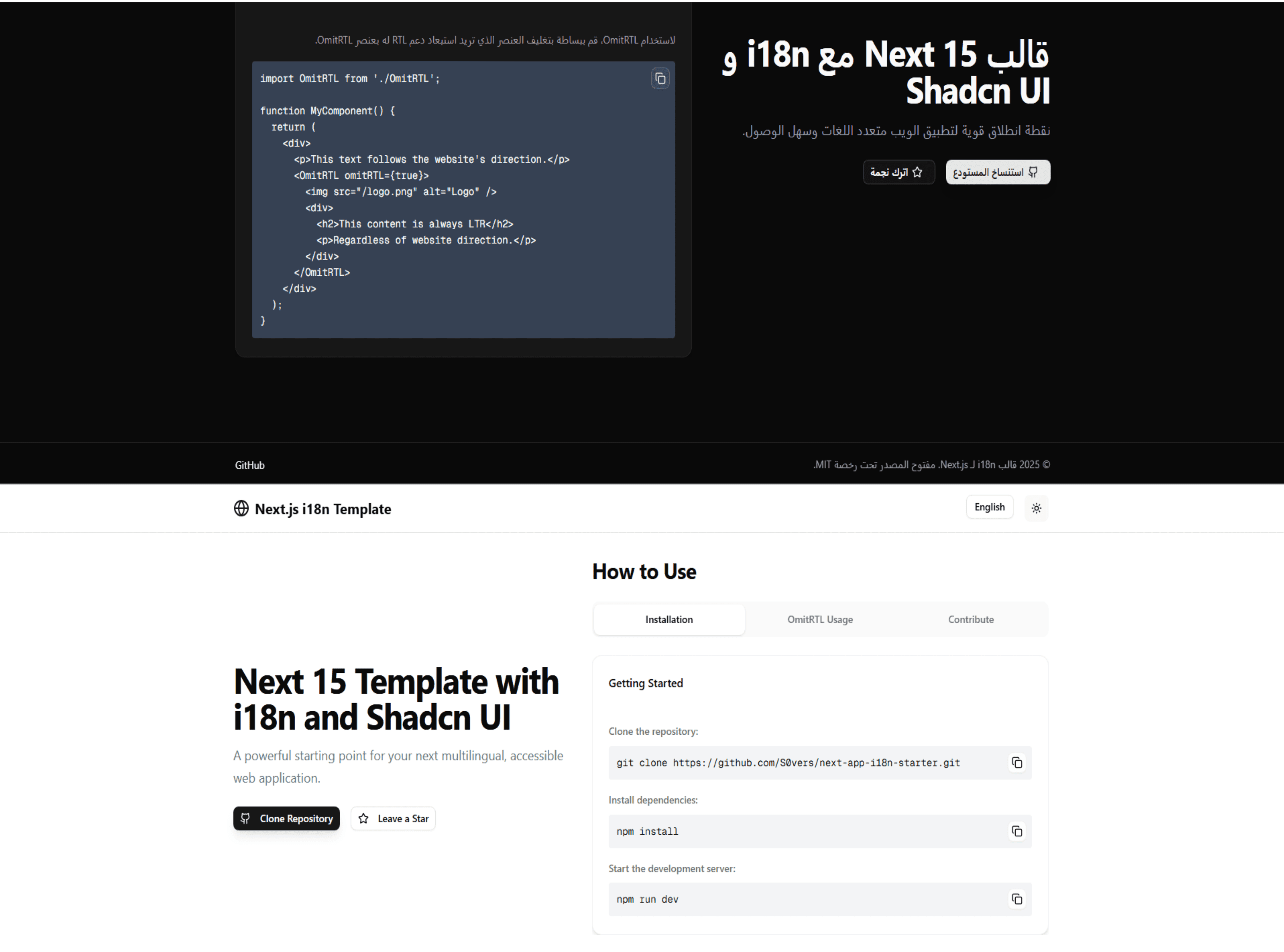
- RTL support
- Dynamic metadata generation
The project is designed to help developers quickly build multilingual applications with a production-ready architecture instead of spending time configuring i18n, SEO, routing, and metadata handling from scratch.
Unlike many boilerplates that focus mostly on visual design, this template focuses heavily on the actual infrastructure required for scalable multilingual applications.
What This Project Solves
Building multilingual applications in Next.js usually requires combining multiple systems manually:
- Locale routing
- Translation management
- SEO metadata
- hreflang tags
- OpenGraph support
- RTL handling
- Dynamic sitemap generation
- robots.txt configuration
- Middleware handling
This project combines all of those into a single production-ready starter architecture.
The template is especially useful for:
- SaaS applications
- Marketing websites
- Enterprise dashboards
- International products
- SEO-focused multilingual websites
Core Features
⚡ Next.js 15 + App Router
The project is built on Next.js 15 using the App Router and React Server Components.
This enables:
- Better performance
- Reduced client-side JavaScript
- Streaming support
- Nested layouts
- Improved SEO handling
- Server-first rendering
🌍 Internationalization with next-intl
The template uses middleware-based internationalization powered by next-intl.
Language files are stored inside the
dictionary/ directory:Currently supported languages:
- English (
en)
- Arabic (
ar)
- Chinese (
zh)
- Spanish (
es)
- Japanese (
ja)
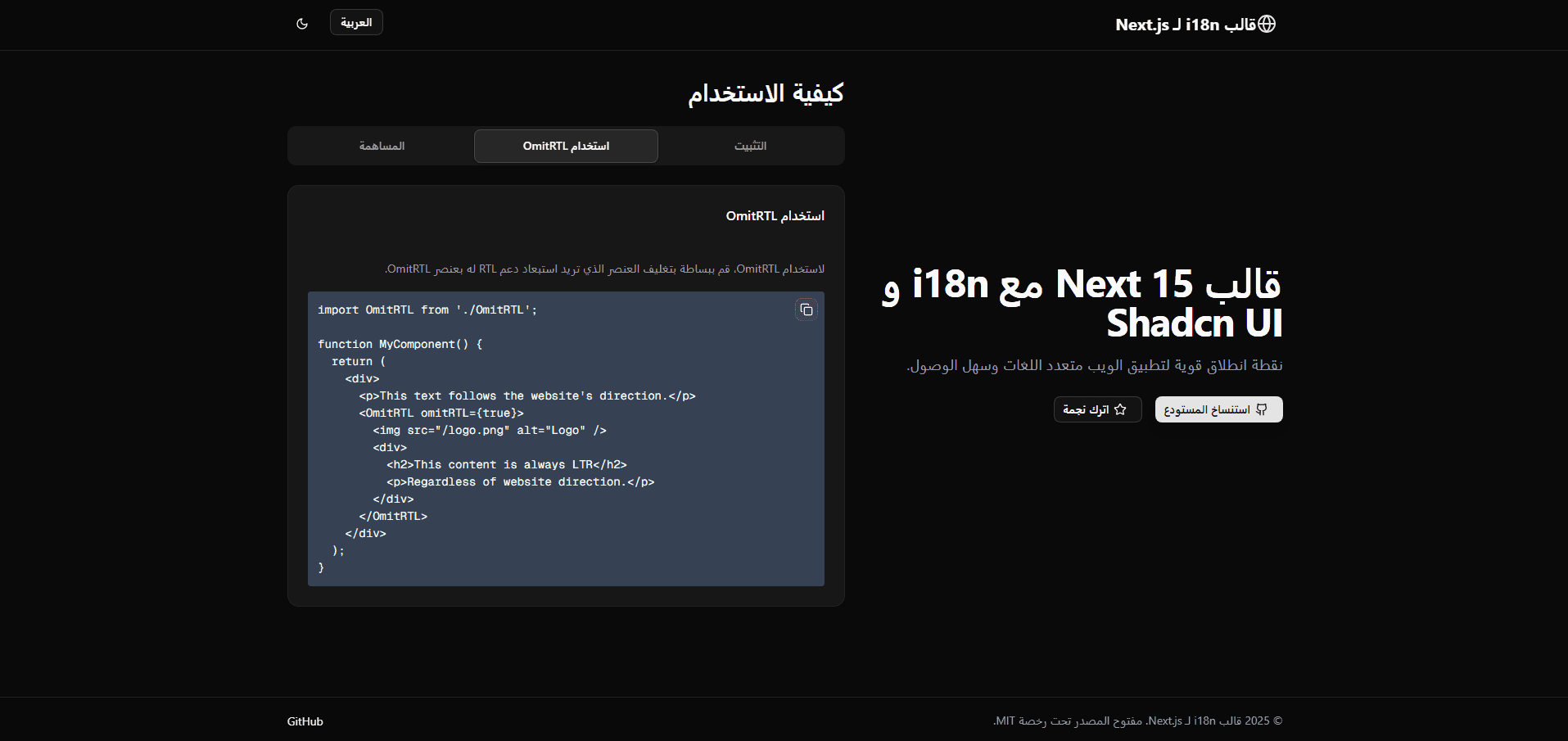
Arabic includes full RTL support.
🌍 Localized App Router Architecture
The project uses dynamic locale segments directly inside the App Router.
This enables route-level localization such as:
Unlike traditional client-only approaches, routes themselves become localized and SEO-friendly.
Internationalization System
The project uses next-intl with middleware-driven routing.
Routing Configuration
The project uses dynamic locale segments directly in the App Router:
This enables localized routes such as:
The middleware handles:
- Automatic locale detection
- Locale-aware routing
- Default locale fallback
- Navigation consistency
- Server-side translation loading
Middleware-Based Locale Detection
The project uses middleware-based locale handling for clean internationalized routing.
Middleware Example
This approach allows:
- Automatic language detection
- Locale-aware redirects
- SEO-friendly URL structures
- Consistent route handling
- Centralized i18n management
Translation Architecture
Translations are organized using dictionary-based JSON structures.
Translation File Example
Translation Usage
This architecture keeps translations modular and scalable as applications grow.
RTL (Right-to-Left) Support
RTL support is one of the major focuses of the project.
Many i18n starters ignore proper RTL architecture, but this project includes:
- Dynamic document direction
- RTL-aware layouts
- Logical spacing support
- Mixed-direction compatibility
- Route-aware direction switching
RTL Example
OmitRTL Utility
One of the unique parts of the project is the built-in OmitRTL utility.
This utility allows specific components to remain LTR even when the website is rendered in RTL mode.
This is useful for:
- Logos
- Code blocks
- Analytics charts
- Technical interfaces
- Embedded widgets
Example Usage
The utility is also available as a standalone npm package:
Route-Safe Navigation
The project includes locale-aware navigation patterns.
Example Navigation
The routing system automatically preserves locale context.
This avoids common issues where users accidentally lose language state during navigation.
SEO Optimization
One of the biggest focuses of the project is multilingual SEO.
The template includes a full SEO setup using the Next.js 15 Metadata API.
Metadata Features Included
- Dynamic metadata generation
- Locale-specific metadata
- OpenGraph tags
- Twitter cards
- Canonical URLs
- Hreflang tags
- robots directives
- Google site verification
- Structured data
- Dynamic sitemap generation
Full Metadata Example
Structured Data Example
Dynamic Sitemap Example
These SEO features make the project production-ready for multilingual websites and international search indexing.
A major focus of the project is multilingual SEO.
Included SEO Features
- hreflang support
- Localized metadata
- Dynamic sitemap generation
- Canonical URLs
- Open Graph metadata
- Route-based SEO handling
Metadata Example
This makes the starter suitable for real production applications and international websites.
Folder Structure
The project architecture was designed to keep localization isolated and scalable.
This separation keeps the i18n layer maintainable for larger applications.
Why This Project Matters
Many Next.js internationalization tutorials stop at simple translation examples.
This project focuses on how multilingual systems actually work in production:
- Locale-aware routing
- Middleware architecture
- RTL support
- SEO optimization
- Translation scaling
- App Router integration
- Server component compatibility
It acts as both:
- A production-ready starter
- A learning resource for advanced i18n architecture in Next.js
Open Source
This project is fully open source and available for developers to explore, modify, and contribute to.
If you are building multilingual applications using Next.js, this project can serve as a strong architectural foundation.
Final Thoughts
Next App i18n Starter is more than a simple multilingual demo.
It is a production-oriented architecture template for building modern internationalized applications using:
- Next.js 15
- App Router
- React Server Components
- next-intl
- Metadata API
- Structured data
- Middleware-based localization
- Dynamic SEO handling
- RTL support
The project combines internationalization, SEO, routing, metadata management, and UI infrastructure into a single scalable starter.
For developers building multilingual SaaS platforms, international products, or SEO-focused websites, this template provides a strong foundation with modern Next.js best practices already implemented.
Key Features
Server Components & App Router
Middleware i18n (next-intl)
Five locales (en, ar, zh, es, ja)
RTL layouts + OmitRTL utility
Light/dark theme toggle
Repo layout and docs oriented for fast onboarding and customization
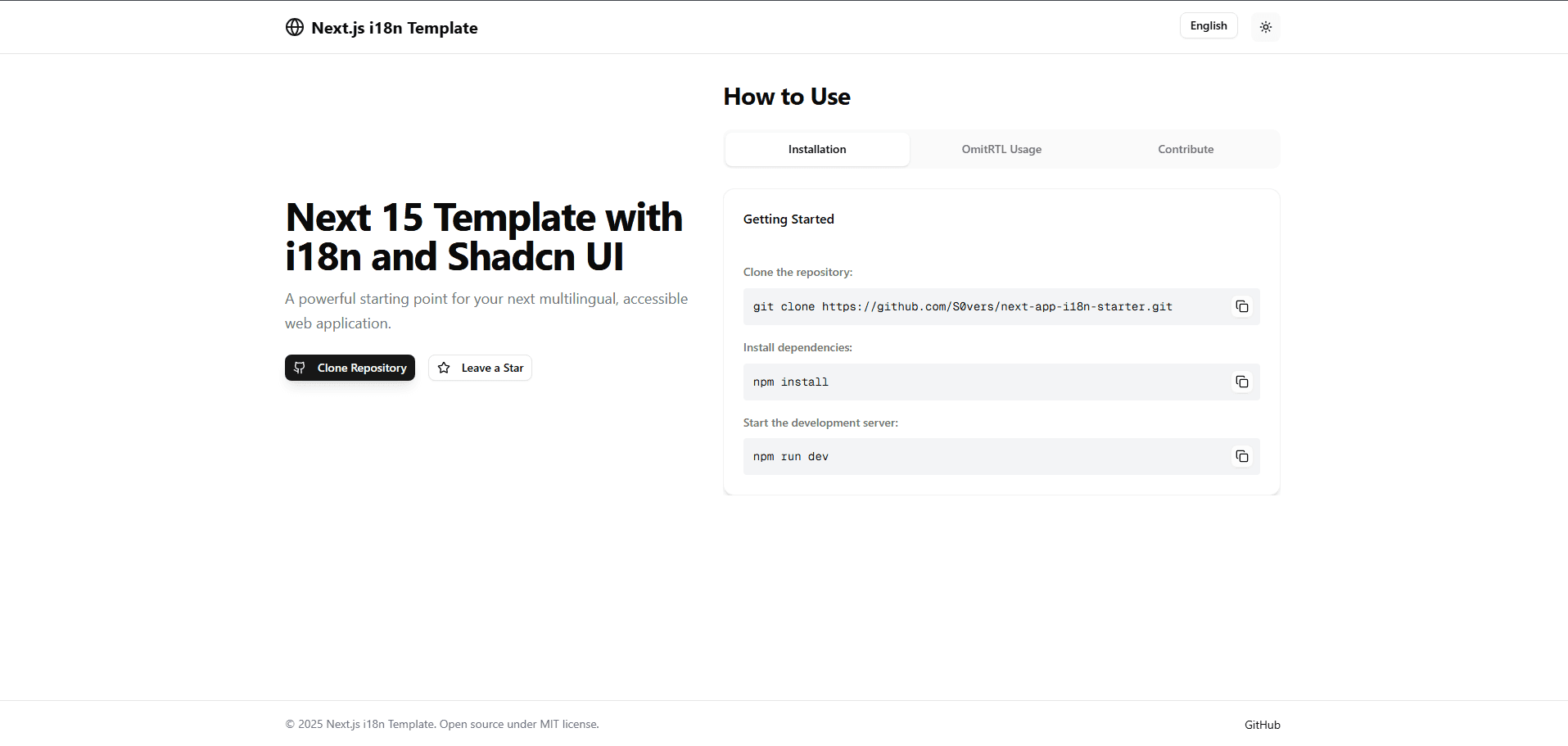
Screenshots
Technologies Used
Next.js
TypeScript
next-intl
shadcn/ui
Tailwind CSS